Recognition is not a break from the work. Done well, it is one of the ways leaders teach the work.
That distinction matters because recognition is often treated as something separate from operations: a morale initiative, an awards program, a nice thing to remember when the calendar allows it. Those things can have value. But the most useful recognition usually happens much closer to the moment itself.
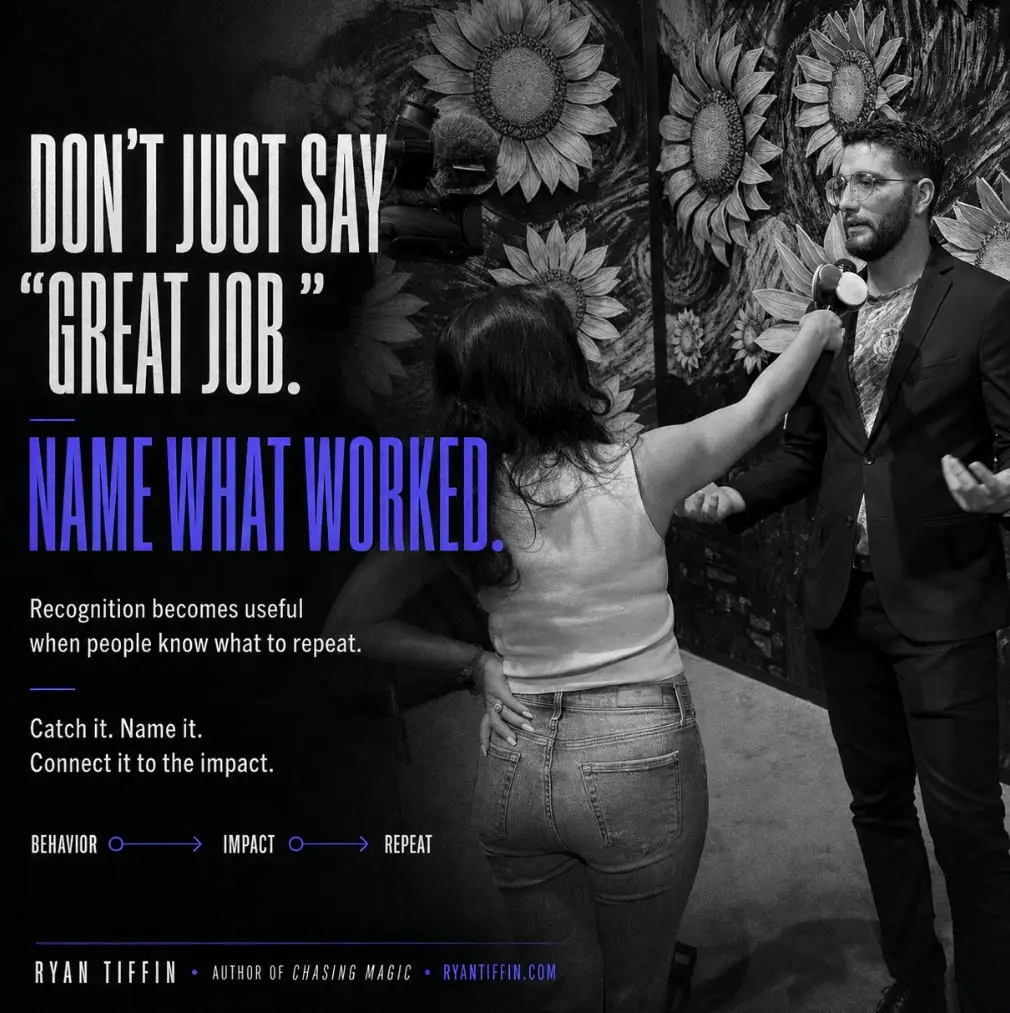
A leader sees a behavior worth repeating, names it clearly, and connects it to the impact it created.
That is not fluff. That is information.
Recognition becomes powerful when it tells people what good looks like.
“Great job” is kind. It is also incomplete.
There is nothing wrong with telling someone they did a great job. The problem is that the phrase does not give the person much to carry forward.
What was great? The decision? The preparation? The way they communicated? The way they protected the guest experience? The way they helped another employee succeed?
If people have to guess, the recognition may create a good feeling without creating much clarity.
Specific recognition does both.
Instead of simply saying, “You handled that well,” a leader can name what actually happened: “You stayed calm, explained the next step clearly, and gave the guest confidence that someone owned the issue.”
Now the employee has evidence. They know what the leader noticed. They know what behavior mattered. And they have a much better chance of repeating it.
Recognition is a signal
Culture is built from signals. People watch what gets rewarded, what gets corrected, what gets ignored, and what leaders consistently make time to notice.
If an organization says it values teamwork but only recognizes individual heroics, people notice. If it says guest experience matters but praise is reserved almost entirely for sales numbers, people notice that too. If leaders repeatedly recognize calm handoffs, proactive communication, thoughtful recovery, preparation, and ownership, those behaviors begin to feel more visibly connected to the standard.
This is why recognition can be an operating habit rather than an occasional event.
Every specific callout answers a quiet question employees are always asking: What does good look like here?
Use three parts: what, why, who
Recognition does not need a script, but a simple structure helps keep it useful:
What they did keeps the recognition specific. “You caught the missing information before the handoff.” “You noticed the guest was confused and stopped to explain the next step.” “You checked on the new team member before they had to ask for help.”
Why it helped connects the behavior to the operation. Maybe it prevented rework, reduced uncertainty, protected a timeline, made a recovery easier, or kept a small issue from becoming a larger one.
Who felt the impact connects the work to people. A guest felt more confident. A teammate had what they needed. Another department avoided a surprise. A leader could make a better decision because the information arrived clearly.
That final piece is easy to skip, but it often gives the work meaning. People are more likely to understand the value of a behavior when they can see who benefited from it.
Recognize the work that prevents problems
Some of the most valuable work in hospitality, attractions, communications, and operations is nearly invisible when it is done well.
A clean handoff does not generate a complaint. Good preparation does not create drama. Clear communication can prevent the escalation that would have made the work suddenly visible. A thoughtful leader may solve a staffing or workflow problem before most of the team ever knows it existed.
That creates a recognition trap: the people creating stability can receive less attention than the people responding to visible emergencies.
Leaders should deliberately look for the quiet work that keeps experiences moving.
Who made the day easier before it got hard? Who created clarity before confusion spread? Who helped a teammate without being asked? Who protected the guest experience in a way nobody had to recover from later?
Those behaviors deserve to be named precisely because they can disappear inside a successful day.
Recognition and accountability belong together
Sometimes recognition gets framed as the opposite of accountability. Strong leaders need to correct problems, hold standards, and have difficult conversations, so recognition can get pushed into the “nice to have” category.
But recognition and accountability do the same important job from different directions: they make the standard visible.
Accountability says, “This missed the standard, and here is what needs to change.” Specific recognition says, “This is the standard in action, and here is why it mattered.”
A team needs both. If people only hear what went wrong, they learn what to avoid. If they also hear exactly what worked, they learn what to repeat.
Build it into the operating rhythm
The goal is not to create one more program that leaders have to administer. It is to make noticing part of leadership.
A pre-shift can include one specific example from yesterday. A project debrief can name the behavior that saved time or protected quality. A one-on-one can include a recent moment the employee may not realize was noticed. A quick message can take thirty seconds and still be specific enough to matter.
The best recognition often sounds less like a ceremony and more like a leader paying attention.
That is the habit: see it, name it, reinforce it.
One useful question for today
Before the day ends, ask yourself: What is one behavior on this team that deserves to be named more often?
Then find the person who demonstrated it and tell them three things: what they did, why it helped, and who felt the impact.
You do not need a trophy. You do not need a budget. You do not even need a meeting.
You need enough attention to make good work visible.
Recognition is not extra. It is one of the ways people learn that their work mattered—and what great work looks like here.
Explore more experience-led leadership ideas in Chasing Magic Insights, learn about consulting and workshops, or explore Chasing Magic: How Experience Changes Lives and Shapes Leaders.
Leadership gets practical when the idea can survive the next shift.
Explore more essays on guest experience, operations leadership, employee experience, and the everyday decisions that shape how people feel.
Browse all Insights