Belonging is easy to celebrate when there is a campaign around it. The harder test is whether people can feel it on a random Wednesday, in an ordinary meeting, during a difficult shift, or in the quiet moment after someone decides whether it is safe to speak.
Organizations can write belonging into values statements, training decks, recruitment language, and annual celebrations. Those things can signal intent. But intent is not the same as experience.
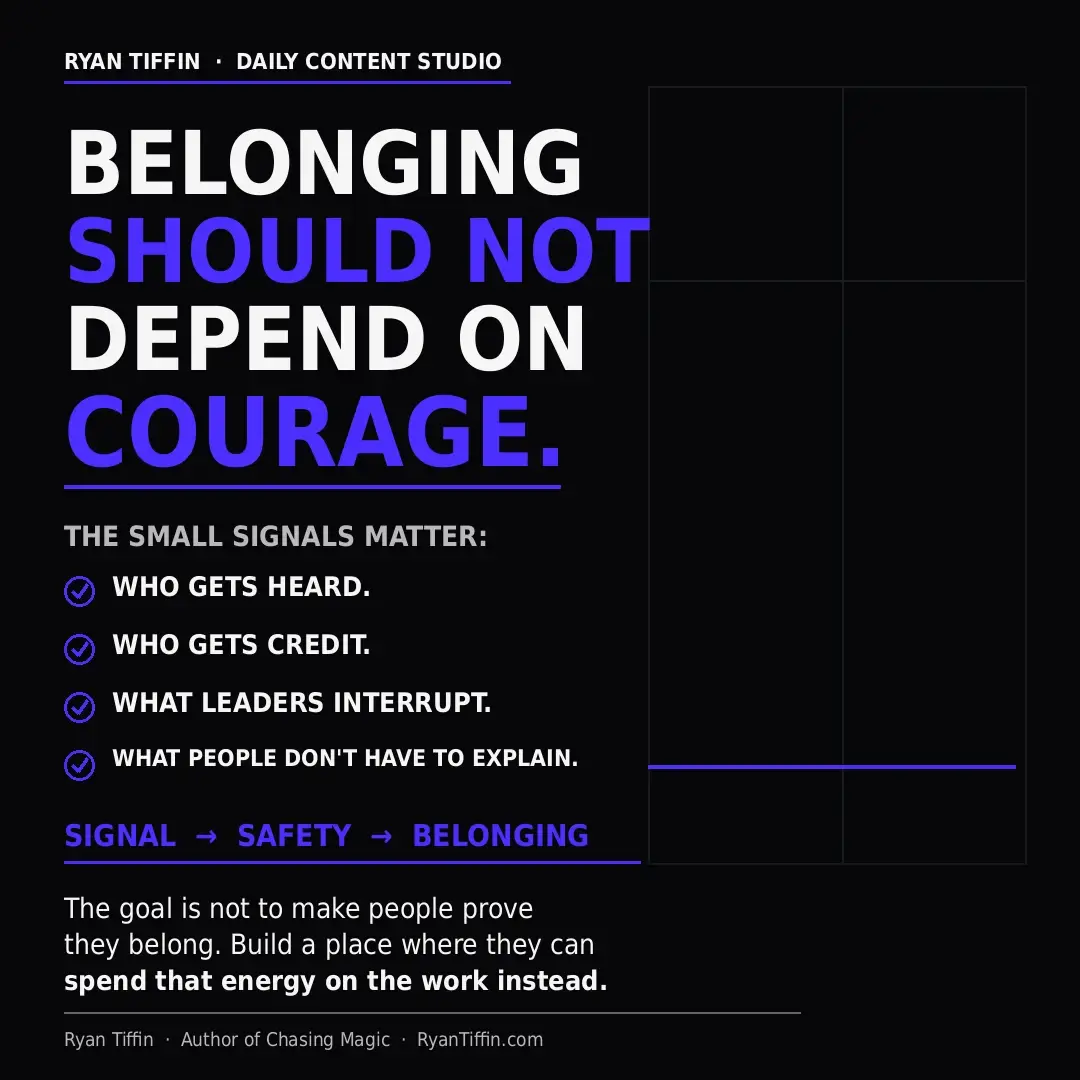
People learn whether they belong through repetition. They notice who gets interrupted and who gets protected. They notice whose ideas receive credit. They notice whether a joke that crosses a line gets addressed or politely ignored. They notice whether they can bring their full perspective into the room without first editing the parts that might make someone else uncomfortable.
A brand can announce its values. Culture proves them in the ordinary moments.
Belonging is behavioral
One reason belonging can become corporate wallpaper is that we sometimes describe it as a feeling without talking about the behaviors that create the feeling.
Feeling seen often begins with someone noticing. Feeling heard requires someone making room for a voice and taking it seriously. Feeling safe depends on what happens after a person is honest. Feeling valued shows up in credit, opportunity, recognition, feedback, and trust.
None of those require a perfect speech from a leader. They require attention.
A leader can ask whose perspective is missing before closing a decision. They can redirect credit to the person who originated the idea. They can address disrespect without asking the person affected to carry the entire burden of correcting it. They can make recognition broad enough to reach beyond the loudest or most visible person on the team.
Small behaviors are not small when they repeat every day. Repetition is how culture gets built.
People should not have to become smaller to succeed
For LGBTQ+ people, belonging at work can include a calculation other employees never have to make: How much of myself is useful to reveal here? Will this change how I am perceived? Is this room genuinely safe, or merely polite?
That calculation is not limited to LGBTQ+ employees, of course. Anyone who has felt different from the dominant culture of a workplace can recognize the instinct to scan a room before deciding how fully to enter it.
Inclusive leadership reduces the amount of energy people have to spend on that calculation.
The goal is not to make identity the center of every conversation. It is to build an environment where identity does not become a tax on participation. People should be able to contribute an idea, disagree respectfully, ask a question, pursue an opportunity, or simply talk about their lives without wondering whether authenticity will quietly alter their professional standing.
That is what I mean when I think about whether people can exhale.
The employee experience eventually reaches the guest
Belonging is sometimes treated as a People-team initiative sitting somewhere separate from operations or guest experience. I think that misses the larger system.
Teams do not leave their employee experience backstage when they step in front of a guest.
If people spend their shift protecting themselves, navigating unclear expectations, absorbing disrespect, or wondering whether their voice matters, that consumes attention. If they feel trusted, respected, and able to contribute, they have more capacity to notice the person in front of them.
That does not mean a happy employee automatically creates a perfect guest experience. Operations still need staffing, standards, training, tools, and accountability. But culture changes the amount of human energy available inside those systems.
A team that can exhale has more room to listen, improvise, recover, create, and care.
Watch what happens when nobody is watching
Culture is easiest to perform when the audience is present. The more useful evidence appears when there is no campaign, executive visit, survey window, or public spotlight.
What happens in the group chat? What happens when a guest makes a disrespectful comment toward an employee? What happens when the same person is interrupted for the third time? What happens when someone uses the wrong name or pronoun after being corrected? What happens when a quieter employee produces excellent work that is less visible than someone else’s?
Those moments teach the team what the organization actually protects.
Policies matter because people need clear expectations and recourse. But a policy cannot notice the moment for you. Leadership has to live between the lines of the handbook.
Recognition is part of belonging
I return often to recognition because visibility and belonging are closely connected.
Recognition does not have to be elaborate. Sometimes it is naming the contribution accurately. Sometimes it is making sure the person who did the work is in the room when the work is discussed. Sometimes it is asking for someone’s perspective because you know they see something the rest of the team may miss.
The opposite is also true. People learn quickly when recognition repeatedly flows toward the same personalities while invisible labor stays invisible.
Leaders should ask not only, “Who performed well?” but also, “Whose contribution might I be overlooking because of how this workplace rewards visibility?”
That question can change a culture.
A practical belonging check
You do not need another poster to start improving belonging. Watch an ordinary day and ask:
- Who speaks easily, and who seems to calculate before speaking?
- Whose ideas get repeated, credited, or ignored?
- What happens when disrespect appears in a small, socially awkward form?
- Does recognition reach different personalities, roles, identities, and shifts?
- Can people disagree with a leader without paying a relationship penalty?
- Do employees have enough psychological room to ask for help before a problem becomes a failure?
The answers will tell you more about belonging than the values page ever could.
Make room, then prove the room is real
Belonging is not about lowering standards or avoiding accountability. Strong cultures can be candid, demanding, and performance-driven. The difference is whether people understand that dignity is not conditional on perfect performance or sameness.
People can be coached and still feel valued. They can disagree and still feel safe. They can be different without being treated as difficult.
That is the leadership work: not simply inviting people into the room, but building enough trust that they can actually contribute once they arrive.
People remember whether they could exhale. And when they can, they have more of themselves available for the work, the team, and the people they serve.
Explore more experience-led leadership ideas in Chasing Magic Insights, learn about consulting and workshops, or explore Chasing Magic: How Experience Changes Lives and Shapes Leaders.
Leadership gets practical when the idea can survive the next shift.
Explore more essays on guest experience, operations leadership, employee experience, and the everyday decisions that shape how people feel.
Browse all Insights