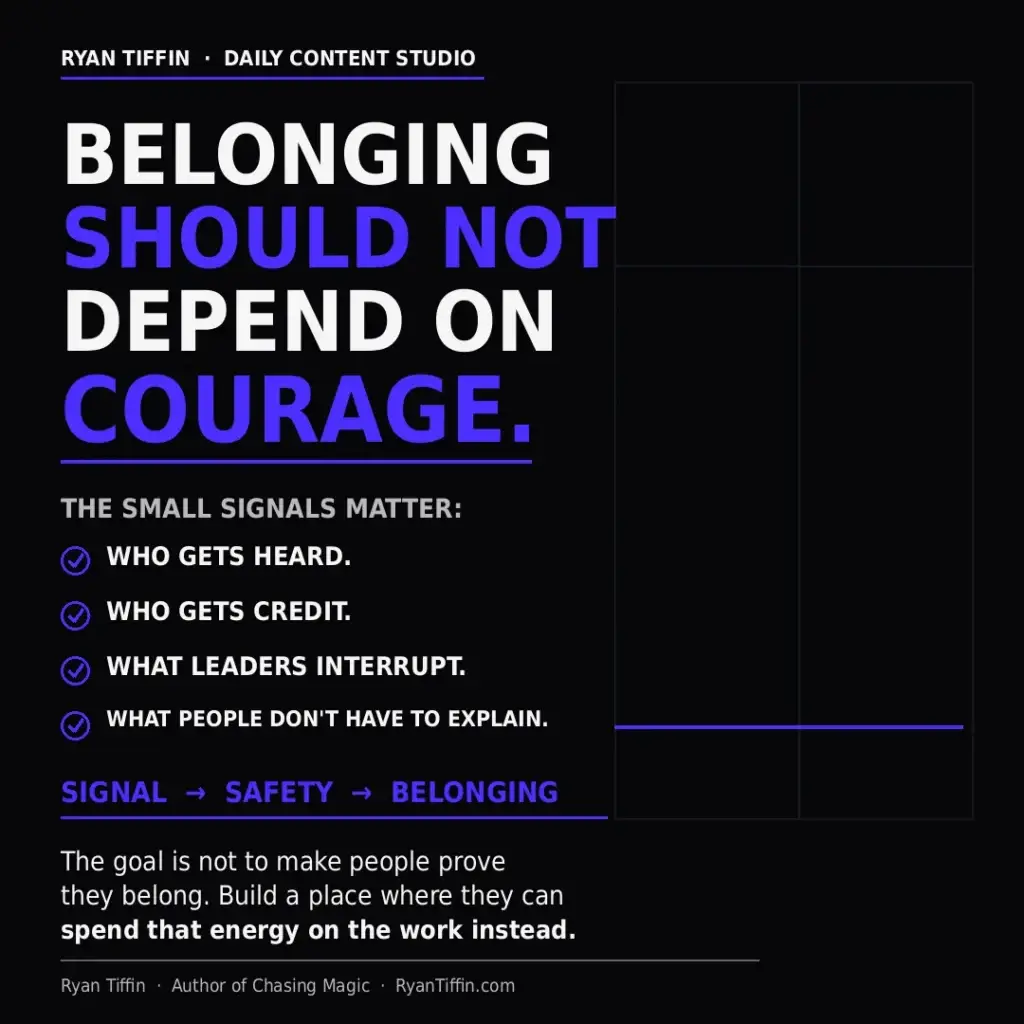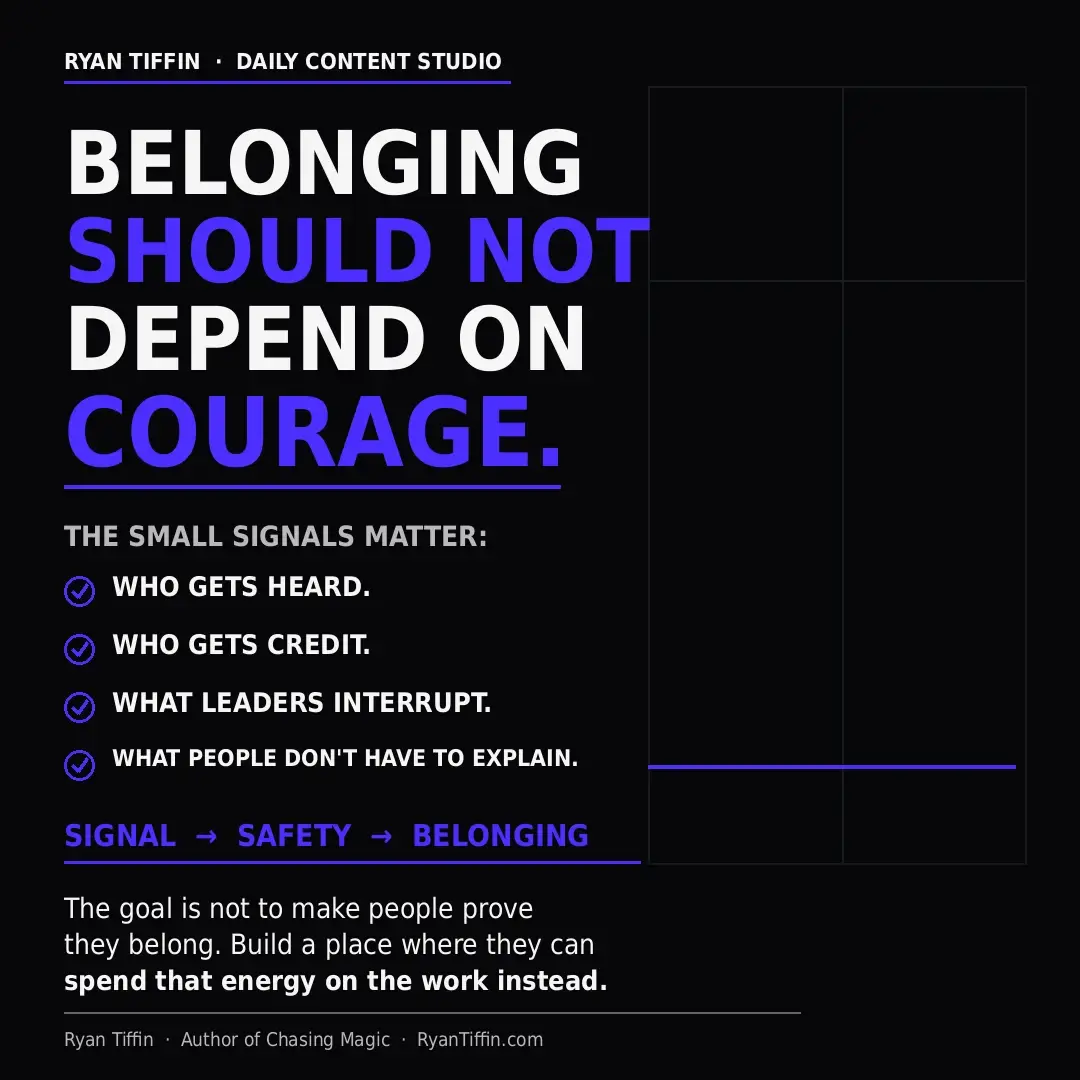
Belonging should not depend on courage. People should not have to spend a meaningful part of the workday deciding whether it is safe to speak, whether their idea will be credited, whether a joke will be challenged, or how much of themselves they need to edit before they can contribute.
Belonging is rarely created by one big statement. It is built through the smaller signals people experience every day.
Culture lives in what the room teaches people to expect.
Employee belonging is an operating condition
Belonging is sometimes treated as a culture initiative that sits beside the “real work.” In practice, it affects the work directly. When people spend less energy protecting themselves from the room, they have more energy available for judgment, creativity, service, problem-solving, and collaboration.
That makes belonging relevant to employee experience, leadership, and operational performance—not only to values statements.
Small leadership signals matter
Employees are constantly reading the environment for evidence about what is safe and what is valued. Some of the strongest signals are small:
- Who gets heard without fighting for the floor?
- Who gets credit when an idea works?
- Whose contribution gets interrupted or talked over?
- What behavior does a leader stop instead of quietly letting pass?
- Who is expected to explain themselves before everyone else can move on?
- Whose mistakes are treated as learning and whose are treated as proof?
Inclusive leadership is visible in everyday decisions
A leader does not need a formal culture initiative to send a useful signal. Giving credit accurately, inviting the quieter person into the conversation, interrupting disrespect, explaining an inside reference, or asking whose perspective is missing can all change what the room communicates.
These behaviors matter because inclusion becomes credible through repetition. People watch what gets rewarded, ignored, corrected, and protected.
Belonging and accountability can coexist
Belonging does not mean every idea is accepted or every performance issue disappears. Healthy teams can have clear standards, candid feedback, and meaningful accountability while still treating people with dignity and consistency.
In fact, clarity can strengthen belonging because people are less likely to wonder whether expectations are being applied differently depending on who is in the room.
Ask what your leadership makes people believe
It is easy for a leader to believe everyone belongs. The more useful question is whether everyday behavior makes that belief visible.
Who gets invited into the conversation? Who receives credit? What crosses a line? Who can ask a question without paying a social penalty? Those answers tell employees far more about culture than a poster does.
Spend less energy proving you belong
The goal is not to make people become braver just to participate. The goal is to build an environment where courage is not the entry fee for ordinary contribution.
When people can spend less energy proving they belong, they can spend more energy doing the work.
Reflection: What small leadership behavior has made a workplace feel more inclusive to you?
Leadership gets practical when the idea can survive the next shift.
Explore more essays on guest experience, operations leadership, employee experience, and the everyday decisions that shape how people feel.
Browse all Insights